Discover Your Neighborhood’s Biggest Polluters with Our New Tracker
As part of its commitment to protect everyone’s right to a healthy environment, Clean Air Council helps residents track the pollution permits that industrial facilities apply for across Pennsylvania. To make it even easier for the public to understand what kinds of pollution are affecting their neighborhoods, the Council created a brand new tool. The Pollution Tracker is based on years of Clean Air Council’s work monitoring and analyzing the applications submitted by businesses to permit them to release pollutants into the air and water. By exploring this tool, residents can look up major facilities in Southeast Pennsylvania, discover permits companies have applied for, where sites have violated those permits, and what action the Council has taken to inform surrounding communities.
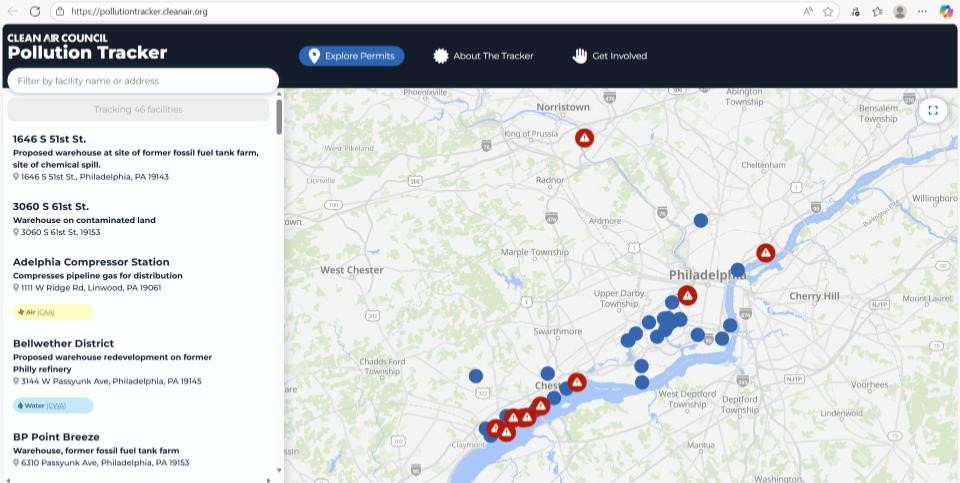
The site, built by Philly-based designer Dain Saint, currently hosts data for many facilities throughout Southwest Philadelphia and Delaware County. It’s simple to use: explore the map and click on the blue or red dots to open detailed entries. If you know the name or address of a facility, you can also search for it directly. For each site, you’ll first find a listing of its name, address, and a brief description or label.
Within each entry, depending on the site, you may also discover information about the facility from the offices of Pennsylvania’s Department of Environmental Protection or the U.S. Environmental Protection Agency. You’ll also learn whether the site has paid any federal penalties in the last five years or if it has a history of previous “Action Alerts” that Clean Air Council has released in response to permit applications at these facilities. Each entry also lists known information about any environmental permits filed in compliance with the Clean Air Act, the Clean Water Act, the Emergency Planning and Community Right-to-Know Act, the Resource Conservation and Recovery Act, and the Toxic Substances Control Act. If information about those is available, you’ll find a color-coded card listing its status, including any known violations.
If the dot representing the facility on the map is red, that means the site has recently violated its environmental permits – you can learn more by opening its entry. If a site is represented by a blue dot, the site may have no recent violations. Crucially, however, that does not mean that the facility isn’t harming the region or the planet – it simply means that local authorities are not aware that it has released more pollutants or waste than it has previously agreed to release. Many of these sites are legally permitted to release harmful substances like greenhouse gases (which bake our planet), particulate matter (which can contribute to respiratory illness), or carcinogens. Still others are not required to have monitoring or tracking equipment for these purposes, which only means we do not know whether they are releasing pollutants at all. Given that Southeastern Pennsylvania regularly fails national ambient air quality standards (NAAQS) and the region has an unusually high rate of respiratory problems like childhood asthma, it’s critical that efforts be made to comprehend the impacts of the region’s dense industrial development.
The goal of the Pollution Tracker is to help residents remain informed about the many industrial facilities in our region and partake in the public engagement processes surrounding their siting, development, and permitting. Clean Air Council regularly helps residents participate in these processes so that we can all protect public health in Southeastern Pennsylvania and reduce the emissions causing the climate crisis.
The Pollution Tracker will be updated regularly as the Council continues this work. If you’re interested in learning more about the Tracker, have questions about its contents, or want to get involved, contact Clean Air Council Advocate Russell Zerbo at rzerbo@cleanair.org.
