
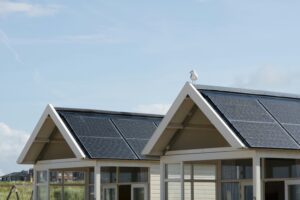
On January 1, 2026, the federal government’s “Big Beautiful Bill” (BBB) will end a major financial perk for US homeowners: the 30% residential solar tax credit. On average, this credit saved homeowners $7,500 when installing panels and an additional $9,000 in electricity savings.
Wondering if you should still invest in solar panels? The answer is yes. Panels installed and turned on before the end of 2025 will still get the tax credit. And even if you miss the end of year deadline, it is still worth buying panels because we still have fair net metering in PA (getting credits for your solar energy!).
Read on to learn how the BBB will impact your energy bill and how you can lower costs by investing in solar.
How does the BBB cut the solar tax credit?
The bill ends the residential tax credit of 30% for any clean energy expenses, such as solar panels, paid for after December 31, 2025. Homeowners who install solar panels on or after January 1, 2026 will not receive the 30% federal tax credit. Crucially, the 30% credit only applies to solar panel purchases, not leases.
Why will the BBB raise individuals’ energy bills?
Research from Energy Innovation, Rhodium, the REPEAT Project, and plenty of other groups all indicate that the BBB will raise our electricity costs. Meanwhile, America is about to need more electricity than ever before. AI companies are building data centers all over the country that are “on course to account for almost half of the growth in electricity demand.” Frequent heat waves are also driving up electricity demand due to air conditioning use.
Economics 101 teaches us that high demand and low supply lead to high prices. So with this high electricity demand, the best way to keep energy prices low is to maintain a healthy supply of energy sources.
The BBB takes the opposite approach. It limits our ability to access energy by making clean energy more expensive with tax credit cuts and exclusively benefiting fossil fuel companies—providing generous tax deductions, federal land and water leases, methane fee eliminations, among other perks.
Fossil fuels are more expensive to generate because companies have to extract and transport the fuel. Their pricing is also volatile because the fuel supply is limited and dependent on global events. Just a few years ago, the Russia-Ukraine war spiked gas prices because so many countries depended on oil from the region.
Solar lowers energy bills because it’s cheaper to operate than fossil fuel generators, thanks to improved panel technology and efficiency in recent years. In 2023, the International Energy Agency (IEA) reported that an estimated 96% of new solar and wind plants had lower generation costs than new natural gas and coal plants, and 75% of them produced cheaper energy than the natural gas and coal plants. These financial benefits are exactly why so many countries across the world are investing in solar energy—including China, which just opened the world’s largest solar farm.
3 steps for getting solar panels (and saving as much as possible)
Prepare for rising electricity costs by investing in solar ASAP. With or without the tax credit, solar panels will cut your electricity costs thanks to PA’s fair net metering (more on that below!). Maximize these savings by following these tips throughout your solar panel process.
1. Collect installer recommendations and quotes ASAP
In an ideal world, you’re able to buy and install solar panels before the end of 2025 and get the 30% residential solar tax credit. That timeline is tight, though—especially since the full process usually takes 6 months, and many people will be trying to get the tax credit.
If your goal is getting the credit, you’ll need to find potential installers ASAP by:
- Asking local friends and family with solar panels for installer recommendations. A referral you trust is by far the fastest way to find a reliable solar installer.
- Using an online solar quote comparison tool, like EnergySage or Solar.com. Pick the top 5 to 7 quotes based on your budget. If you’re overwhelmed by the information in each quote, this resource can help you decipher the details.
- Reading online reviews to narrow down your picks. The solar quote comparison tools, Yelp, and Google are all great resources for finding installer reviews. Check what buyers say about each installer’s quality of service and typical timelines, so you can gauge whether completing your panels by 2025 is realistic.
Pick your top 3 installers after following the steps above, and call each one to set up consultations.
2. Determine the best way to pay for your panels
Solar panels are a major purchase, like a car, so most people end up financing them rather than buying them upfront. If you go this route, ask each installer at their consultation if they can set a payback period length that sets the monthly rate at the average amount of your monthly electricity bill. This setup essentially makes the panels free.
Of course, this monthly rate will change depending on whether you receive the federal 30% tax credit by installing the panels before 2026. Stay on the safe side by assuming you won’t receive the credit when evaluating monthly payments and payback period lengths. This approach will leave you happy with your installer agreement regardless of whether you make the 2026 deadline. And if you do receive the credit, you get the benefit of a lower monthly payment and/or a shorter payback period.
If you don’t want to finance your panels or pay for them upfront, some installers offer alternative ways to generate and use solar energy at your home. A power purchase agreement allows you to purchase solar energy generated at your home for a set period while the installer owns and maintains the panel system.
Or, an installer may offer a lease agreement. Never sign a solar lease with escalator pricing, which lets the provider increase the rate over time. Ensure you’ll save money over your entire lease agreement by only agreeing to a flat monthly rate.
Be sure to closely read the paperwork of your installer agreement so you understand the terms, particularly if you choose one of these alternative options.
3. Sit back, relax, and enjoy your solar savings
Choose one installer based on the consultations, and they’ll handle the remaining steps of the process. In addition to handling the physical installation, your solar company will manage the various permits and certifications that are required to get your new solar panels up and running (and connected to the grid).
Once your solar panels are installed, it’s time to enjoy net metering! In PA, net metering is thankfully a fair 1-to-1 credit system–meaning, solar users are paid the same per kilowatt hour as they would have been charged to consume that kilowatt hour. Solar installers here will automatically set up net metering, but this benefit is also common in many other states. If you live outside of PA, be sure to ask your installer (1) if you’re eligible for net metering and (2) if so, what kind of support they offer to set it up for customers.
Can’t buy or lease panels? Demand community solar!
If buying or leasing panels doesn’t feel right for you, don’t count yourself out of solar! Consider community solar—a system where residents subscribe to a local solar farm and receive credits on their energy bill.
Community solar isn’t available in PA yet, but Clean Air Council is hoping to change that. Take action and tell your local PA politicians you want them to support legislation that allows community solar.
Philadelphia, PA (January 31, 2022)
This project/program was funded (in part) by the Pa. Department of Health’s Preventive Health and Health Services Block Grant.
Feet First Philly is Philadelphia’s only pedestrian advocacy group. The group is sponsored by Clean Air Council. For the second consecutive year, the Council and Feet First Philly partnered with the Philadelphia Department of Public Health to provide funding for neighborhoods to improve walkability in their communities. The projects awarded are located throughout Philadelphia and all seek to enhance public spaces.
This mini-grant program was created to allow community groups, residents, and even local businesses to become active in improving public spaces, by using community-led designs to improve safety and beauty. This program demonstrates ways in which a small amount of funding can have a big impact on neighborhoods when residents lead the effort. A historic lack of investment in public spaces in Philadelphia’s communities of color is a chronic problem, this mini-grant program prioritizes those neighborhoods that have historically been overlooked.
In the first year of the mini-grant program, Feet First Philly funded seven amazing projects. This year, over 60 residents, businesses, and community organizations submitted applications. Thanks to the city funds which were supplemented by our generous donors, the program will be able to support a total of nine mini-grants this year.
The projects selected will implement unique strategies to address different barriers to public spaces in their neighborhood. Feet First Philly recently announced the first 5 projects and will announce the additional four winners in the near future.
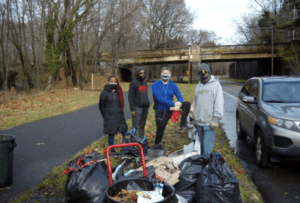
Cobbs Creek Ambassadors will expand its efforts in cleaning up the Cobbs Creek Trail. This year, the group “aims to establish a Trash, Trees, and Trails (T³) mission, a more holistic approach to engaging neighbors in the park’s revitalization.”
Norris Square Neighborhood will install community bulletin boards in front of two of their garden spaces to provide various information to neighborhood residents and create more welcoming spaces for neighbors to enjoy.
Southwest Community Development Corporation will create an outdoor space for community members to access and engage in various activities. This space will act as a pocket park for the neighborhood.
ACHIEVEability will increase safety, cleanliness, and neighborhood pride by beautifying the 60th Street Commercial Corridor between Arch and Chestnut Streets.
Hansberry Garden and Nature Center will enhance a meadow as a local walking destination with a welcome sign, seating area, and other amenities.
The additional four awardees will be announced soon. Follow Feet First Philly on Facebook, Twitter, and Instagram for updates on the additional projects!
For more information contact Titania Markland, Transportation Outreach Coordinator, tmarkland@cleanair.org.
Philadelphia, PA (January 30, 2022) The Pennsylvania Department of Environmental Protection (DEP) claims to care about environmental justice. It has a policy in place that it claims ensures the fair treatment and meaningful involvement of all people regardless of race, color, national origin, or income when it comes to environmental policies and protections. This policy was implemented in response to a 2001 report that detailed the significant substantive and procedural problems with permitting that have created inequity in the distribution of environmental harms. Yet time and again, when facing real-world environmental issues, DEP’s commitment to environmental justice comes up short.
As one of the state’s oldest environmental nonprofits, Clean Air Council has a long history of working with DEP. In these interactions, the Council has found the Department unwilling to commit to meaningfully apply its own Environmental Justice Public Participation Policy. Such lack of commitment is only more frustrating because that policy already fails to go nearly far enough to fully address environmental injustice in Pennsylvania. The Policy only provides a modicum of additional public information and participation opportunities when certain new permits are about to be issued, and does nothing to strike at the heart of environmental injustice: it does not give DEP guidance on when to deny or strengthen permits, even where it has the authority to do so.
The Policy, even if properly followed, therefore does little more than inform low-income communities and communities of color about the environmental harms they face. These are often communities that lack the resources to hire experts to fully explain what the potential harm to health, quality of life, and local ecosystems might be. It does nothing to address the historical and continuing injustice these communities face from the cumulative impacts of many sources of pollution over many years.
DEP is currently updating this environmental justice policy. According to StateImpact Pennsylvania, DEP wants the new policy to position DEP as a better resource for environmental justice communities. The public wants that, too. Surveys have shown that Americans consider environmental justice to be a pressing issue in our communities. DEP has launched a process to gather public input to strengthen its EJ Policy, but the Department must then treat that document as more than mere suggestions to be forgotten or outright ignored.
It’s time for the Wolf administration to get serious about environmental justice not just on paper, but in practice. Indeed, many environmental justice communities and their advocates have little trust that a revised policy will be taken any more seriously by DEP leadership. DEP needs to acknowledge the power and resource imbalance between these communities and the polluting industries seeking to externalize costs onto community members, and DEP needs to become an advocate for the community in the face of this imbalance. What EJ communities need and have a right to are concrete environmental justice regulations that must be enforced by either DEP or, failing that, the courts.
The Pennsylvania House Black Caucus introduced a bill back in October that would allow DEP to deny permits for the cumulative or disproportionate impacts they could have on disadvantaged communities. But the Wolf administration does not need to wait for legislative action. As the Council has pointed out to the DEP in comments, current laws like the Air Pollution Control Act grant DEP the power – and the responsibility – to deny permits for the harm they could cause to a community’s health. If the DEP wants to improve its environmental justice policy, it must take that responsibility seriously.
For more information contact Legal Fellow Joseph A. Ingrao, Esq. jingrao@cleanair.org.
