As we approach the new year, many of us like to think of resolutions for the coming months. Clean Air Council would like to recommend adding composting to your new habits for 2026. This blog post will provide you with what you need to start composting in your own backyard.
If you’re located in Clairton, Braddock, North Braddock, or Swissvale, PA, and are interested in getting involved with a local composting effort in your community, fill in our contact form. The Council will be distributing more FREE compost bins to households and community centers in the new year. Fill out the form now to apply for yours!
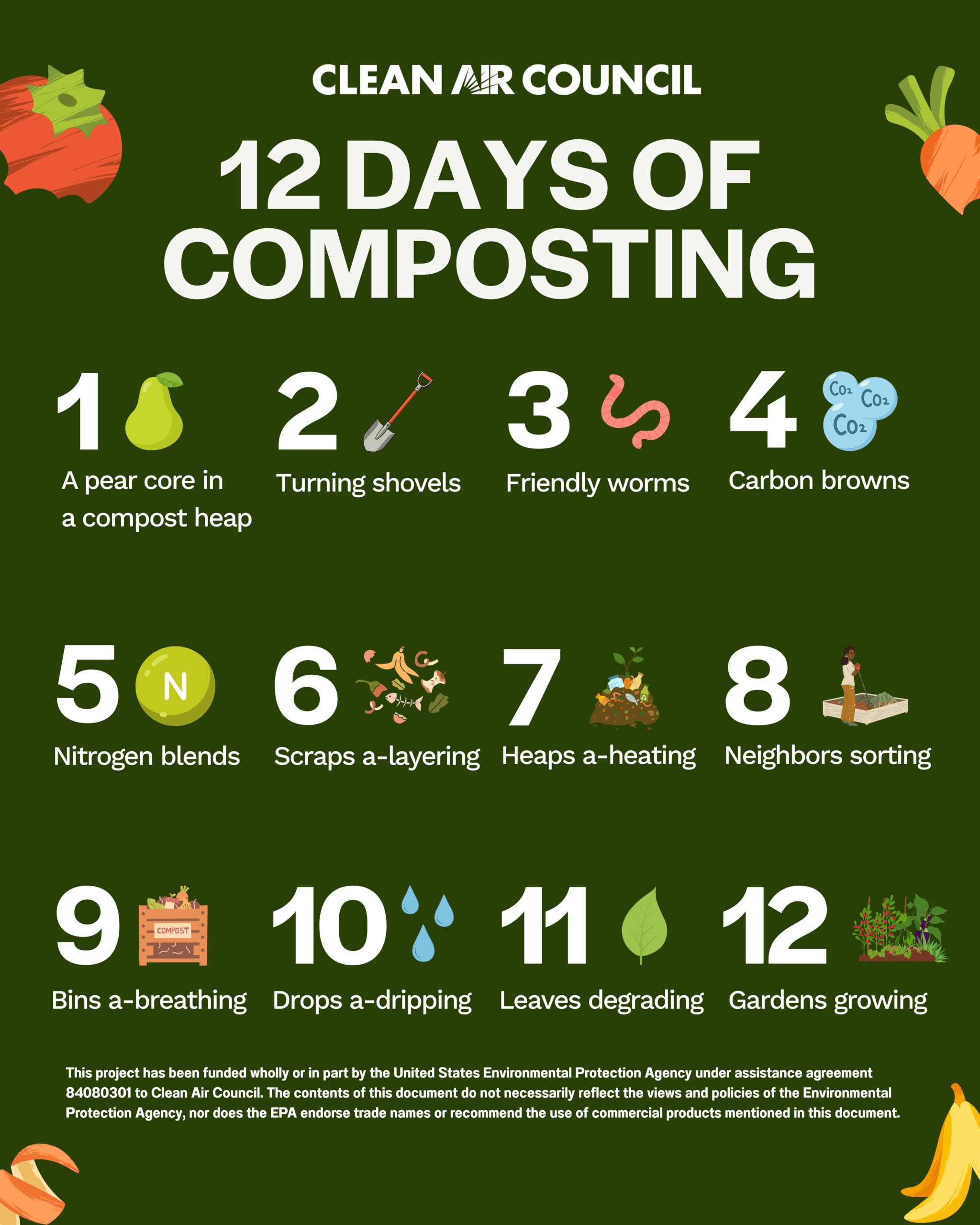
On the 12 days of Compost my true love gave to me…
- A pear core in a compost heap
To get started with composting, you’ll need access to a compost bin or heap. Whether you prefer composting in an open pile, a multi-stage bin, a worm composter, or a tumbling bin, make sure to have an area or a container for this purpose.
- Two turning shovels
Other equipment you might want to consider for your composting needs include a shovel or pitchfork, a kitchen countertop bin for collecting your kitchen scraps, and a thermometer to keep track of the health of your compost pile.
- Three friendly worms
While vermicomposting is its own ecosystem altogether, compost bins of most kinds will benefit from having some friendly earthworms in the mix, breaking down your compost waste quicker and more efficiently. You can buy red wigglers to add to your bin, or you can wait for them to naturally turn up in an open-bottom stationary bin.
- Four carbon browns
It’s important to know what can and cannot be composted. One crucial element to add into your pile is browns, or carbon-rich materials, like dry leaves, straw, or plain shredded cardboard.
- Fiiiive nitrogen blends
The second essential material to add to your bin is greens, or nitrogen-rich materials, such as grass clippings, fruit peels, or coffee grounds.
- Six scraps a-layering
Adding greens and browns to your bin, make sure to layer them to the best of your ability to ensure the two types of materials mix together well. This will kickstart the biodegrading process and offers microbes, bacteria, and fungi ideal conditions to get to work.
- Seven heaps a-heating
It’s very important for your pile to achieve a high enough temperature in order for your compost waste to mature into nutrient-rich compost. You can track this by using a compost thermometer – very similar to the meat thermometer you might use for cooking your Christmas meal.
- Eight neighbors sorting
Composting can be more fun and efficient if you team up with your neighbors! Maybe one of you has a bigger yard with ample space for a compost bin, but is lacking enough greens. Recruit the vegetable-loving family of four across the street to donate their scraps to an effort to create you both organic, home-made compost.
- Nine bins a-breathing
It’s also essential for the microscopic friends in our compost bins to have enough oxygen to break down matter effectively. Help them by turning or mixing your compost pile regularly, ideally once a week or two.
- Ten drops a-dripping
In reality, you don’t want your compost bin to be soggy – the texture of your compost should resemble a wrung-out sponge. If the bin gets too wet, add more browns and mix well.
- Eleven leaves degrading
Ensuring all these conditions are met, composting will be a breeze and you’ll help divert waste from landfills to save you money in the garden instead!
- Twelve gardens growing
The final result is fresh, earthy compost for your garden beds, potting mixes, and lawns. The best part is that you get to share these results with your neighbors and community, creating a healthier environment for us all.

In celebration of Earth Day, Clean Air Council will be tabling and/or in attendance at the following events. We hope to see you there!
Environatal Day at Bartram’s Garden | April 17th 10-2pm
Join Nature Momz at Bartram’s Garden for an organized group walk along the trail to discuss maternal health, air quality, and the impact of the environment on mothers and infants. Free to all and no registration is required.
In partnership with the Philadelphia Regional Center for Children’s Environmental Health, Clear Air Council, Nurturely and a Place for Ummi Maternity Care.
Spring Fest at Bartram’s Garden | April 19th 10-2pm
Join Bartram’s Garden for their annual spring celebration! Activities will include a guided tour of the Garden’s 19th-century flower garden, a youth-led block printing activity, hands-on natural dye activity, an annual plant sale, and so much more. Clean Air Council will be tabling at the event, so stop by to learn more about the smoke contamination issue at Bartram’s Garden.
SEPTA’s Earth Day Celebration | April 21st 11-2pm
SEPTAs Sustainability Department is hosting its annual Earth Day Expo. Check out SEPTAs Zero Emission Fuel Cell buses, learn more about SEPTA’s sustainability practices, and visit Clean Air Councils table to learn more about our transportation programs.
Earth Day Expo at Temple University | April 22nd 11-3pm
Join the Office of Sustainability and TSG Sustainability Committee for an Earth Day Expo to learn more about sustainability on campus through student involvement, departmental research, and action plan development. Clean Air Council will be tabling at the Expo, so stop by to learn more about the Council’s transportation programs.
Swissvale Community Garden Earth Day Cleanup | April 22nd 6-8pm
Join the Swissvale Community Garden to help clean out garden beds and prepare for the growing season. Clean Air Council organizers will be in attendance to discuss our composting program and how to start composting.
Mt. Lebanon Earth Day Event 2025 | April 27th 11-3pm
Join us for live music, vendors, henna art, yoga classes, a kids bike course, and so much more at the Mt. Lebanon Earth Day Event. Stop by Clean Air Councils table to learn more about our programs in Southwest Pennsylvania.
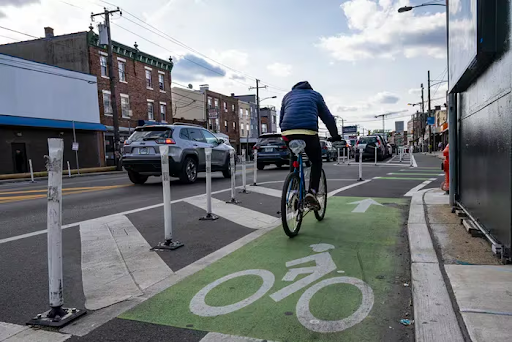
PennDOT released its annual transportation survey for all Pennsylvanians to complete. The survey asks participants about their transportation habits, what type and how they use transportation, and what improvements they want and how they want PennDOT to invest in the future.
Your feedback will be an important part of PennDOT’s 12-year Transportation Program update process along with other state and regional transportation plans. Sustainable modes of transportation are the best for the environment. Clean Air Council supports active sustainable modes of transportation. For more information on how to complete the survey, please visit https://bicyclecoalition.org/penndot-transportation-feedback-survey/.
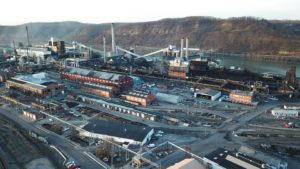
Washington, D.C. – A coalition of clean air advocates filed a federal lawsuit against the EPA
yesterday demanding stronger rules to reduce hazardous air pollution – including cancer-
causing benzene – from steel industry coke oven plants across the country.
Coke oven plants, located in Western Pennsylvania, Northern Indiana, Alabama and a dozen
other locations in the U.S., superheat coal in a kiln without oxygen to produce a carbon-dense
coal byproduct that is used in iron and steel manufacturing.
Because these plants release large amounts of air pollution, the U.S. Environmental Protection
Agency on July 5 imposed new regulations meant to control their hazardous emissions,
including benzene, mercury, lead, and arsenic.
The Environmental Integrity Project, Earthjustice, Clean Air Council, Sierra Club, and PANIC filed
a lawsuit challenging the new rules in the United States Court of Appeals for the District of
Columbia Circuit because the regulations did not go far enough to control benzene, exposing
communities downwind from coke oven plants to dangerous levels of this carcinogen.
“EPA failed to impose strong enough standards to adequately protect the public, and failed to
require industry to install modern pollution control technologies that are readily available,” said
Haley Lewis, attorney for the Environmental Integrity Project. “The public health risk is
unacceptable, and so we are asking the D.C. Circuit Court to intervene.”
Tosh Sagar, Earthjustice attorney, said: “For decades, the EPA has ignored setting coke oven
standards, allowing cancer-causing pollutants to harm communities in Pennsylvania, Alabama,
Indiana, Michigan, and Ohio. These communities have suffered enough. We’re urging the D.C.
Circuit to force the EPA to finally do its job and protect them.”
Alex Bomstein, Clean Air Council Executive Director, said: “Pennsylvania steel communities
have lived with dangerous air quality for generations. That needs to end. All of us deserve the
cleanest air for the health of our families and our communities, no matter where we live.”
Among the facilities that would be impacted by the rule is the largest coke works in North
America, the U.S. Steel Clairton plant southeast of Pittsburgh, where air pollution monitors
have detected dangerously high levels of benzene.
Other coke works where unhealthy levels of benzene have been detected include Indiana’s
Cleveland Cliffs Burns Harbor plant, beside Lake Michigan; and ABC Coke in Birmingham,
Alabama.
For a copy of the EPA regulations that are being challenged, click here.
For a copy of the lawsuit filed yesterday, click here.
The Environmental Integrity Project and coalition of allied groups sent EPA a detailed critique of
the new hazardous air pollution regulations, which you can read here.
