

But New Report Warns That Recent One-Time Biden Grants to PA Department of Environmental Protection Will be Cut Under Trump
Washington, DC – At a time when the Trump Administration is proposing sharp cuts to the U.S. Environmental Protection Agency, claiming that states can take on more responsibility for environmental oversight, more than half of states (27) have cut their environmental agency budgets over the last 15 years, according to EIP’s report, “State of Decline: Cuts to State Pollution Control Agencies Compound Damage from the Dismantling of EPA.”
Three states reported recent jumps in pollution-control funding — Pennsylvania, Idaho, and Tennessee — from short-term federal grants during the Biden Administration. These temporary boosts in federal funding for state environmental agencies will not continue under the Trump Administration, meaning that these states could see sharp declines in federal support for their state environmental agencies in upcoming years.
In 2024, the PA Department of Environmental Protection’s (DEP) budget rocketed upwards by 62 percent in just one year. This was mainly because of a one-time injection of funds that Pennsylvania received from the Biden Administration’s climate and infrastructure initiatives. The number of full-time equivalent DEP employees increased by 136 (or 5.5 percent) in one year. But even with this increase, staffing still remains similar to what it was a decade and a half ago, before much of the fracking boom. DEP had 2,552 employees in fiscal 2010 and 2,597 employees in 2024.
“Pennsylvania threw the doors wide open to the depredations of the fracking industry two decades ago, but has not given its Department of Environmental Protection the resources to keep it in line,” said Alex Bomstein, Executive Director of the Clean Air Council. “We are now all suffering the sickness and pollution from our leaders letting a lawless industry run wild through our neighborhoods and backyards.”
Deep reductions at the state level mean that the Trump Administration’s planned downsizing of the EPA – with a vote by Congress planned next month on a proposal to slash EPA’s budget – will have an increased impact on pollution control efforts across the country. Not only will the federal pollution cop no longer be on the beat, state authorities may not show up either — because state inspectors have also been laid off in many areas.
“The Trump Administration is attempting to dismantle EPA and rollback commonsense federal pollution rules, claiming that the states can pick up the slack and protect our communities – but that’s not the case,” said Jen Duggan, Executive Director of the Environmental Integrity Project. “The implementation of our environmental laws depend on both a strong EPA and state agencies that have the resources they need to do their jobs. But our research found that many states have already cut their pollution control agencies and so more cuts at the federal level will only put more Americans at risk.”
EIP’s report found that seven states reduced their pollution control funding by at least a third from 2010 through 2024, when adjusted for inflation. The steepest budget cuts were led by Mississippi’s decision to slash its environmental agency by 71 percent, South Dakota’s 61 percent cut, and Connecticut’s 51 percent reduction. (See list and map below.)
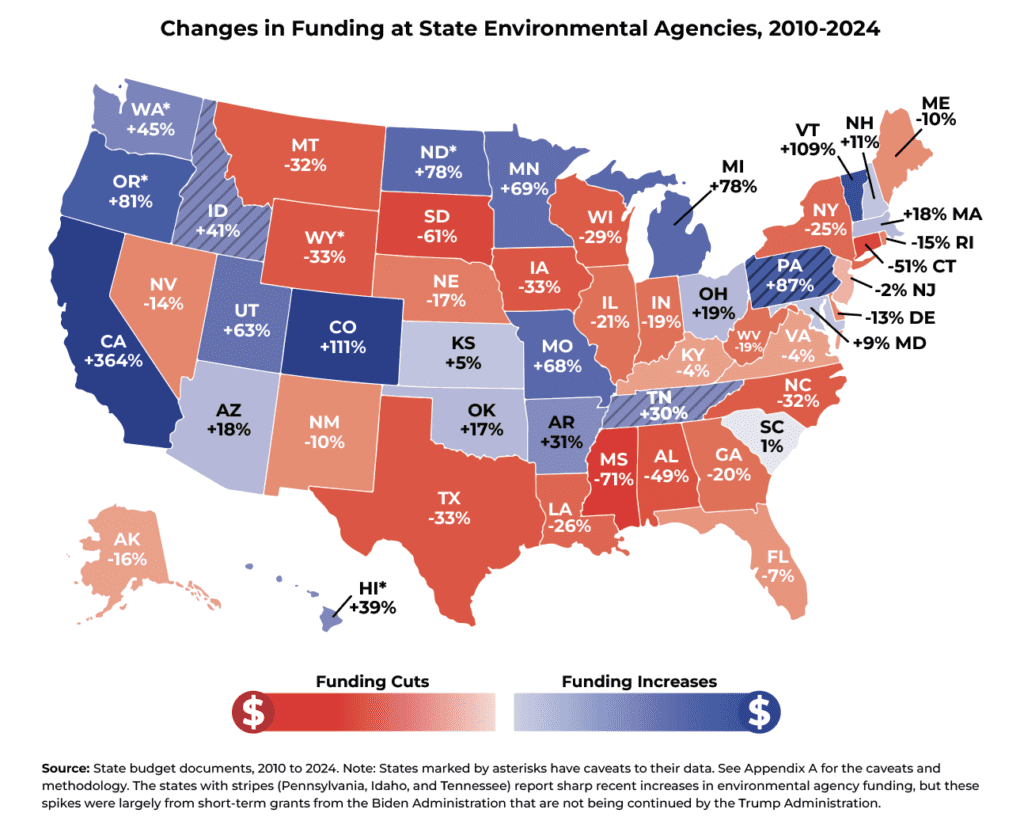
Almost two thirds of states (31) also cut jobs at their environmental agencies from 2010 through 2024, eliminating 3,725 positions over this period, with North Carolina imposing the steepest percentage cuts (32 percent), followed by Connecticut (26 percent), Arizona (25 percent), and Louisiana (24 percent)
California led a handful of states — including Colorado and Vermont — that have dramatically increased funding for their environmental agencies since 2010. In part as a response to climate change, California quadrupled its state spending on pollution control programs over the last 15 years, while its greenhouse gas emissions fell and its economic productivity grew.
Among the findings of EIP’s report:
- The Texas Commission on Environmental Quality (TCEQ) had its budget slashed by 33 percent, when adjusted for inflation, from 2010 to 2024, seventh most among states. At the same time, the number of facilities in Texas with air pollution control permits grew significantly, including for the expanding oil and gas industry.
- Louisiana faces growing environmental challenges from a booming LNG industry, but reduced funding for the Department of Environmental Quality by 26 percent from 2010 to 2024, when adjusted for inflation, and cut staffing at the pollution control agency by 24 percent, with the latter ranking fourth highest in the U.S.
- Florida, a rapidly growing state, cut the largest total number of jobs from its state pollution control agency from 2010 to 2024, reducing staffing at the Department of Environmental Protection from 2,096 to 1,702 and cutting 394 jobs (or 19 percent).
- In terms of percentage of staffing cut, North Carolina had the largest percent decrease in personnel at its environmental agency (32 percent), meaning the elimination of 386 environmental agency jobs.
- Collectively, the 27 state agencies with budget decreases had their budgets cut by $1.4 billion (or about 33 percent), when adjusted for inflation, over the last 15 years.
- Nationally, seven of the 10 states with the largest percent cuts to their environmental agencies from 2010 to 2024 had Republican governors in a majority of these 15 years, while only three had mostly Democratic governors.
Cuts to environmental agency budgets have occurred in states controlled by Democrats and Republicans. For example, Connecticut, New York, and Illinois – along with Mississippi and Alabama – have slashed their state environmental agencies over the last 15 years, meaning that residents could be hit with more pollution if EPA does not have the necessary resources to do its job. Illinois trimmed its environmental agency budget by 21 percent over the last 15 years, when adjusted for inflation, even more than Indiana or West Virginia, which had 19 percent cuts.
Inflation-adjusted funding for EPA has been on a gradual decline for about two decades, during both Republican and Democratic administrations. From 2010 to 2025, Congress and the President slashed the agency’s budget by 40 percent from $15 billion in fiscal 2010 to $9 billion in 2025, when adjusting for inflation. Over the same period, EPA’s workforce shrank by at least 18 percent, declining from 17,278 to 14,130. This does not include the thousands of more staff — as much as 33 percent — who have quit or been fired since President Trump’s second inauguration on January 20.
On top of these losses, more cuts to EPA could be coming in January, when Congress is expected to vote on the pollution control agency’s budget for fiscal 2026. The White House has been seeking to slash EPA’s budget by 55 percent, or $4.2 billion, leaving the agency with funding levels not seen in four decades. House Republicans have proposed a 23 percent cut, while the Republican-led Senate Committee on Appropriations has endorsed only a 5 percent cut to EPA.
“The evidence in this report bolsters the case against severe cuts to EPA’s budget and staff, because many states have already weakened critically important programs that are supposed to protect our nation’s waters, lands, and air,” said Duggan. “If both lines of defense fail – with harsh cuts to environmental agencies at both the federal and state level – public health, our natural resources, and the global climate will suffer grave harm.”
For a copy of the report, click here. For a spreadsheet with data on all 50 states, click here.

Feet First Philly’s Public Space Enhancement Mini-Grant Program is back again for the sixth year. This grant program has funded over 64 projects across Philadelphia since 2020, and all city residents and community groups are invited to apply.
This program has a funding focus on supporting communities that historically have had less investment (or active disinvestment) in the built environment and city services. Feet First Philly seeks projects that improve walkability by making neighborhoods safer and easier to walk and roll in. The program has supported many different types of projects over the past few years, based on the belief that residents know their community best and are the best advocates to identify and carry out public space improvements.
Feet First Philly is partnering again with the Philadelphia Department of Public Health to provide funding for projects to create and improve public spaces, particularly in underserved communities. Mini-Grants between $500 and $2,000 will be awarded to address the financial and technical barriers that organizations face when creating or improving public spaces.
Funding can be used to support public space projects, including construction materials, educational materials, event costs, insurance, stipends, staff time, or other needs. Be creative and improve a public space that matters to your community.
You can download the Request For Proposal (RFP) here.
Applications are now open! Applications due on October 1, 2025, at 11:59 PM.

The Public Space Enhancement Mini-Grant Application is open. Use the Google form below to submit your application, email questions to shecht@cleanair.org.
We will be hosting an informational online webinar on Wednesday, August 20, 2025, at 12:00 PM, discussing the application & awarding process, hearing from previous years awardees, and more!
Have questions for us? Request a one-on-one session to discuss your application between now and September 22nd by emailing Sally Hecht, Clean Air Council’s Sustainable Transportation Program Coordinator at shecht@cleanair.org with times that work best for you.
Read about our past mini-grant recipients
First year of mini-grant projects
Second year of mini-grant projects part 1
Second year of mini-grant project part 2
Third year of mini-grant projects part 1
Third year mini-grant projects part 2
Fourth-year mini-grant projects
Fifth year mini-grant projects
