(April 6, 2026) Have you noticed your utility bills getting more expensive each month?
You’re not alone. Energy demand in Pennsylvania has skyrocketed in the last year, due largely to the buildout of AI data centers. At the same time, our grid operator has failed to bring new clean energy projects online. Some have been waiting years for the green light.
While the problem is larger than any one person, households can buffer against rising costs by improving energy efficiency. Act 129, Pennsylvania’s flagship energy efficiency law, helps Pennsylvanians do just that.
Passed in 2009, Act 129 requires large electric utility companies to develop Energy Efficiency and Conservation (EE&C) programs to meet energy efficiency goals.
You might know Act 129 by your electric utility’s name or portal for the program: Duquesne Light’s WATT CHOICES, First Energy’s Save Energy programs, PECO’s energy efficiency portal, and PPL’s energy efficiency hub.
Perhaps you’ve received lightbulbs in the mail; that would likely be Act 129 in action. Through Act 129, customers of these large utilities can get rebates for energy-efficient appliances, energy audits for their homes, and more. Since it was enacted, Act 129 has saved Pennsylvania electric ratepayers $6.4 billion in energy costs.
Act 129 operates in phases. Phase V will start in the summer of 2026 and run for five years. Clean Air Council and partner organizations have been advocating over the last year for stronger EE&C plans that provide real energy savings while addressing rising costs, growing demand, and the impacts of climate-driven extreme weather.
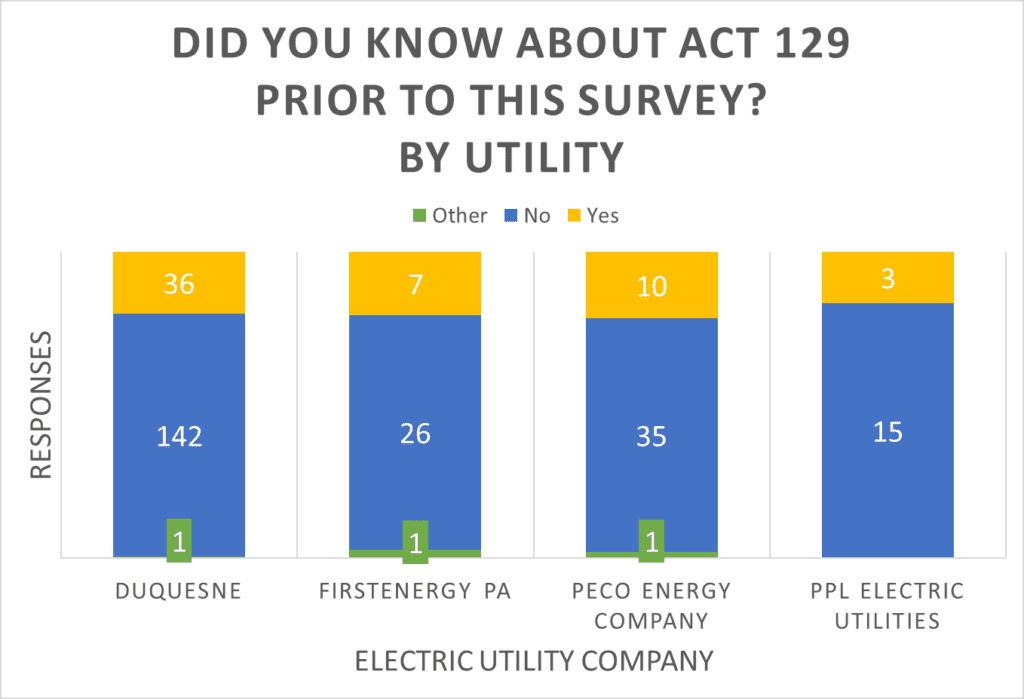
We wanted to learn what ratepayers know about Act 129, so we put together a survey with support from our partners at the Pennsylvania Utility Law Project (PULP) and PA United. Here are a few quick stats about respondents:
- 277 eligible responses, by utility:
- 179 (65%) DLC customers
- 46 (17%) PECO customers
- 34 (12%) FE customers
- 18 (6%) PPL customers
Unsurprisingly, 79% of respondents were not aware of their utility’s Act 129 program. Among those familiar with this program, people said they learned about Act 129 through their own research, media coverage of Act 129, working in a relevant field, and mailers from their utility.
Customers are already paying for Act 129 programs, and they should know about them. Utilities need to do more to educate and promote these offerings so more people can take advantage of it and lower their energy usage and bills
Energy efficiency kits are probably the most well-known utility offering out of Act 129. Maybe you’ve received one in the mail or your kid brought one home from school (PPL provides kits to students). These kits typically include ready-to-use items like efficient lightbulbs, smart power strips, nightlights, and low-flow showerheads. Of the 62 respondents who reported receiving a kit, LED lightbulbs were most commonly-reported (45 responses). Interestingly, several respondents noted they disliked the lightbulbs and would prefer to choose and purchase their own.
While these items are certainly useful to have, the energy they save is small in comparison to other, more comprehensive, interventions like weatherizing homes and upgrading heating, ventilation, and air conditioning (HVAC) systems.

Through this survey, the Council also identified the need for utility companies to better coordinate Act 129 programs with other state and federal programs that also support energy efficiency, health, and safety home improvements.
When we asked what could make home repair programs more accessible, 116 respondents said having a one-stop website for all programs, and 105 said programs should be coordinated programs so that one application applies to all other relevant programs (multiple selections were permitted).
Low-income customers could also benefit from better alignment between Act 129 and utilities’ Low Income Usage Reduction Programs (LIURP), ensuring that eligible households that access one program are referred to the other. Act 129 and LIURP can work together to fill in service gaps, and several self-identified low-income respondents expressed that they didn’t know many of the Act 129 offerings existed before filling out the survey.
Read Clean Air Council’s comments in full here. You can watch a recording of the webinar that Clean Air Council and PULP hosted about Act 129 here.
If you get your electricity from one of the “big four” electric utility companies, you can find rebates and programs that are available to you:
PPL’s energy efficiency hub
Duquesne Light’s WATT CHOICES
First Energy’s Save Energy programs
PECO’s energy efficiency portal,